






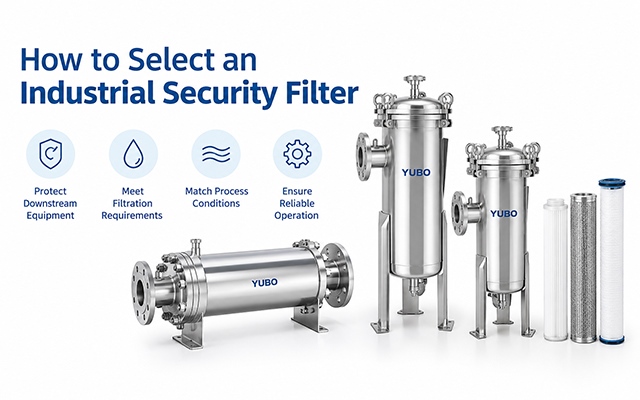
How to Select an Industrial Security Filter
Selecting an industrial security filter starts with the process, not the filter model alone. The right configuration depends on what the filter needs to protect, the fluid being treated, the required filtration level, flow rate, and operating conditions.
Housing and filter element materials, connections, and maintenance requirements should also be considered before the final configuration is confirmed.
For the product detail, to What Is an Industrial Security Filter
1. Start With the Filtration Objective
What does the filter need to protect?
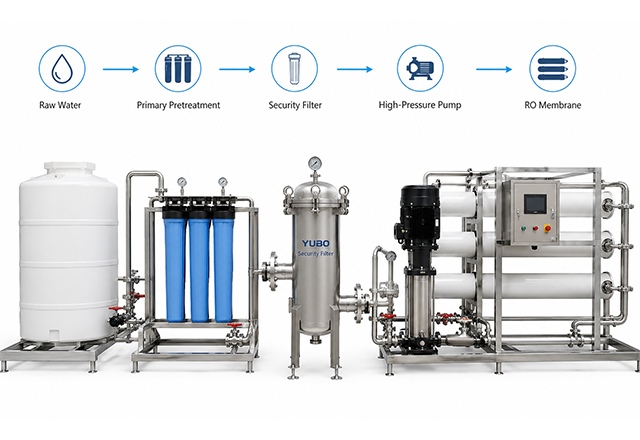
An industrial security filter is typically used as an additional filtration barrier after upstream treatment. Its role may be to:
• Reduce residual particles before RO or UF membranes
• Protect pumps, valves, and process equipment
• Provide additional filtration before a sensitive downstream process
• Help maintain more consistent liquid cleanliness
The amount and type of contamination entering the security filter also matter. If the upstream process already removes most of the larger solids, the security filter can focus on the remaining particle load rather than acting as the primary solids-removal stage.
This is why security filtration should be considered as part of the complete filtration process rather than as an isolated piece of equipment.
2. Match the Filter to the Process
Once the filtration objective is clear, evaluate the actual process conditions.
A. Process Fluid
Identify what the filter will handle. Common industrial applications include:
• Industrial water
• Seawater
• Chemical solutions
• Process liquids
• Food and beverage liquids
• High-purity water
Fluid characteristics can affect both housing and filter element selection. Corrosive liquids, demanding operating conditions, and hygienic processes may require different materials or configurations.
B. Filtration Rating
The required filtration rating should be related to the particles that need to be removed and the requirements of the downstream process.
A finer filtration rating is not automatically a better choice. Moving to a finer element can influence flow resistance, dirt-holding capacity, and service life.
YUBO's technical guidance recommends considering particle size, allowable pressure drop, desired filter life, and the final product requirements when determining the appropriate filtration rating. Where necessary, professional evaluation and laboratory testing can be used to support the selection.
C. Flow Requirement
The filter should provide sufficient capacity for the required process flow without creating unnecessary resistance.
Consider both normal and peak flow conditions. Housing size, cartridge configuration, and available filtration area all affect the practical flow capacity.
Pipe size alone should not be used to select the security filter. The actual liquid, filtration requirement, and operating conditions should be considered together.
3. Check Operating and Material Requirements
After defining the filtration requirement, check whether the filter configuration is suitable for the operating environment.
A. Pressure and Temperature
The selected housing and filter elements should be suitable for the system's operating pressure and temperature.
These parameters should be confirmed before the final model and configuration are selected rather than treated as secondary details.
B. Housing and Element Materials
Material selection should consider the liquid, temperature, pressure, and corrosion environment.
YUBO's industrial security filter range includes stainless-steel configurations, with materials such as SS304 and SS316L available in relevant product series.
The filter element should also be compatible with the process fluid and required filtration performance.
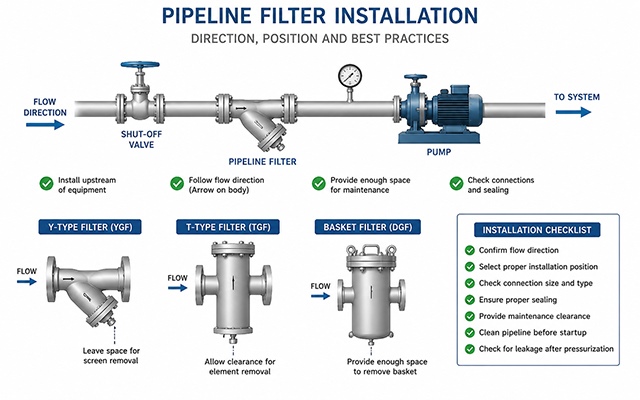
C. Connections and Installation
The inlet and outlet connections should match the existing piping system.
It is also useful to consider:
• Available installation space
• Filter access
• Cartridge replacement space
• Drain or vent requirements where applicable
• Connection standards required by the project
These details can affect how practical the filter is to operate and maintain after installation.
4. Consider Maintenance Before Final Selection
A security filter is part of an operating filtration system, so maintenance should be considered before the equipment is selected.
The basic maintenance cycle is:
Monitor → Inspect → Clean or Replace
The exact procedure depends on the filter element and process conditions.
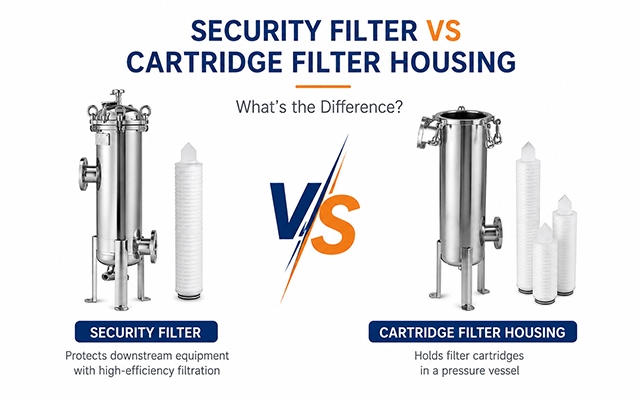
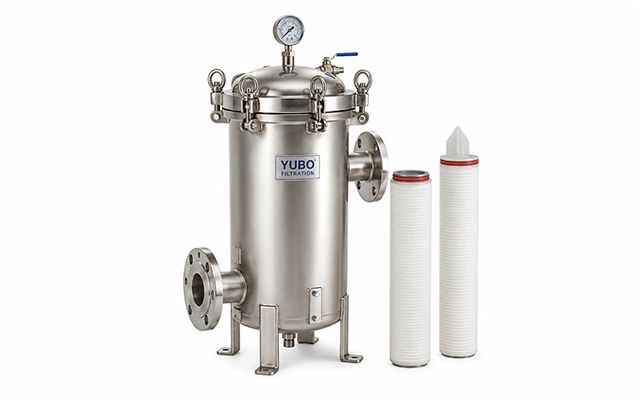
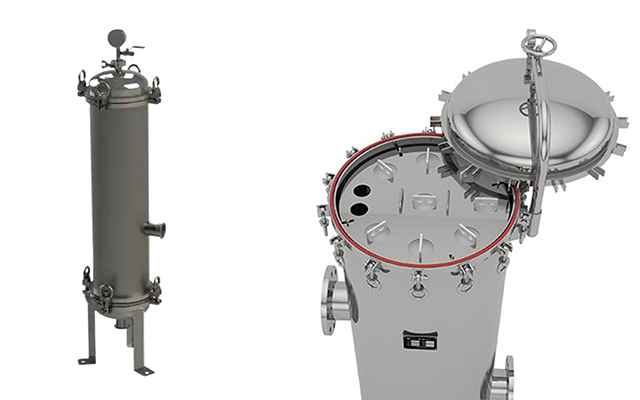
For cartridge-based systems, operators should have practical access to the housing and enough space to inspect or replace cartridges when required.
It is also important to consider how filter condition will be monitored during operation. A configuration that meets the initial filtration requirement but is difficult to inspect or service may not be the best long-term choice.
For this reason, filtration performance, accessibility, and service requirements should be evaluated together.
5. Which YUBO Security Filter Fits Your Application?
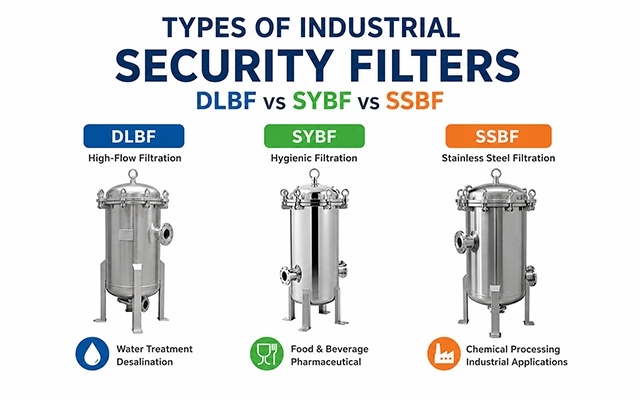
YUBO currently provides three main industrial security filter series: DLBF, SYBF, and SSBF. They are designed for different process requirements.
| Application requirement | YUBO series to consider |
|---|---|
| High-flow industrial filtration | DLBF |
| Food, beverage and pharmaceutical applications | SYBF |
| Stainless-steel industrial filtration | SSBF |
| Seawater and demanding industrial water applications | SSBF / DLBF |
For a more detailed comparison of these configurations, see Types of Industrial Security Filters.
The final selection should still be based on the actual fluid, filtration requirement, flow, pressure, temperature, materials, and installation conditions.
6. What Information Is Needed to Select a Security Filter?
When requesting an industrial security filter, providing the following information can make the selection process more accurate and efficient:
| Information | Why it matters |
|---|---|
| Process fluid | Determines material and element compatibility |
| Flow rate | Helps establish required filtration capacity |
| Filtration rating | Defines the particle-removal requirement |
| Operating pressure | Confirms housing suitability |
| Operating temperature | Helps determine material and element compatibility |
| Housing material | Depends on fluid and operating environment |
| Filter element | Affects filtration performance and service life |
| Connection type | Ensures compatibility with existing piping |
| Installation conditions | Helps determine practical configuration and maintenance access |
Not every project has all of this information at the beginning. However, the more complete the process information is, the easier it is to evaluate a suitable configuration.
For customized filtration projects, YUBO combines product manufacturing with technical evaluation of factors such as structural integrity, pressure testing, flow distribution, material qualification, durability, and safety.
This allows the final configuration to be considered according to the actual application rather than selected only from a standard model list.
FAQ
1. What is the most important factor when selecting a security filter?
The filtration objective should be established first. You need to know what downstream equipment or process needs protection and what residual particles need to be controlled. Flow, pressure, temperature, materials, and maintenance requirements can then be evaluated around that objective.
2. How do I choose the right filtration rating?
The required rating should be based on the particles to be removed and the requirements of the downstream process. Particle size, allowable pressure drop, desired filter life, and final product requirements should be considered together.
3. Does a lower micron rating always mean better filtration?
No. A finer rating may improve particle removal, but it can also affect flow resistance, dirt-holding capacity, and filter service life. The appropriate rating depends on the complete process requirement.
4. Which YUBO security filter should I choose?
YUBO currently offers DLBF, SYBF, and SSBF security filter series. The appropriate series depends on the process, flow requirement, filtration objective, fluid, and operating environment rather than on one factor alone.