






Industrial Security Filter for RO Systems: Role, Placement and Applications
Reverse osmosis (RO) membranes require relatively clean feedwater to operate reliably. Even after upstream pretreatment, fine suspended particles may remain in the water stream. An industrial security filter for RO systems provides an additional filtration barrier before the RO stage, helping reduce residual particulate loading and protect sensitive downstream equipment.
The security filter is therefore not a replacement for RO pretreatment. It is an additional protective stage used when the process requires tighter control of remaining particles.
For a broader explanation of industrial security filtration, see Industrial Security Filter: Types, Applications and How It Works.
Why Is a Security Filter Used Before RO?
RO membranes are sensitive to particulate contamination. Larger contaminants and much of the suspended-solid load are normally addressed by upstream pretreatment, but some fine particles can remain after these stages.
A security filter provides a final or near-final filtration barrier before the RO process. Its main purpose is to reduce the amount of residual particulate matter entering the membrane system.
This can help:
• Reduce particulate loading on RO membranes
• Limit particle-related problems in downstream equipment
• Improve control of feedwater cleanliness
• Provide an additional safeguard when water quality varies
The actual filtration performance depends on the selected filter element, filtration rating, feedwater characteristics and operating conditions.
Where Does the Security Filter Fit in an RO System?
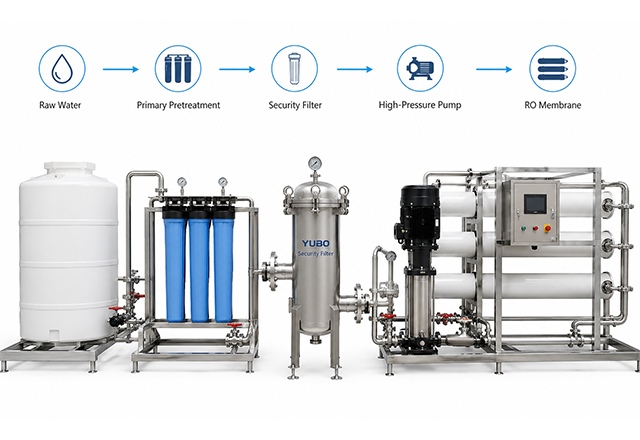
A common arrangement is:
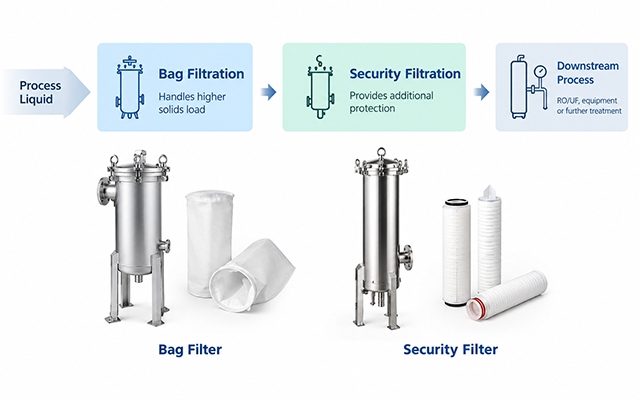
Raw Water → Primary Pretreatment → Security Filter → High-Pressure Pump → RO Membrane
The exact process sequence can vary between systems. The security filter is generally positioned after the main pretreatment stages and before sensitive downstream equipment.
In this arrangement:
• Primary pretreatment handles the main contaminant load.
• Security filtration provides additional control of residual fine particles.
• The high-pressure pump and RO system receive a more controlled feed stream.
This staged approach allows each filtration step to perform a different role rather than requiring the security filter to handle the entire raw-water load.
What Does a Security Filter Protect in an RO System?
The RO membrane is usually the main concern, but membrane protection is not its only role.
| Downstream Component | Security Filter's Role |
|---|---|
| RO Membrane | Reduce residual particulate loading |
| High-Pressure Pump | Help limit particle-related problems |
| Valves & Instruments | Reduce particulate contamination |
| Downstream Process | Provide an additional filtration barrier |
The security filter should be considered part of the overall protection strategy rather than an isolated filtration device.
Can a Security Filter Replace RO Pretreatment?
No.
A security filter does not normally replace the upstream pretreatment required by an RO system.
Pretreatment may include different processes depending on the feedwater and system requirements. These stages can be responsible for removing larger particles, suspended solids or other contaminants before the water reaches the security filter.
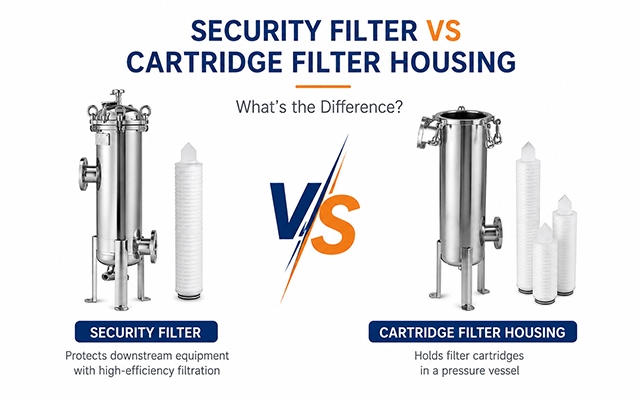
The security filter has a narrower role: providing an additional filtration barrier for residual particles before a sensitive downstream stage.
This distinction is especially important for industrial systems where the incoming water quality and process conditions can change significantly.
What Type of Security Filter Is Used Before RO?
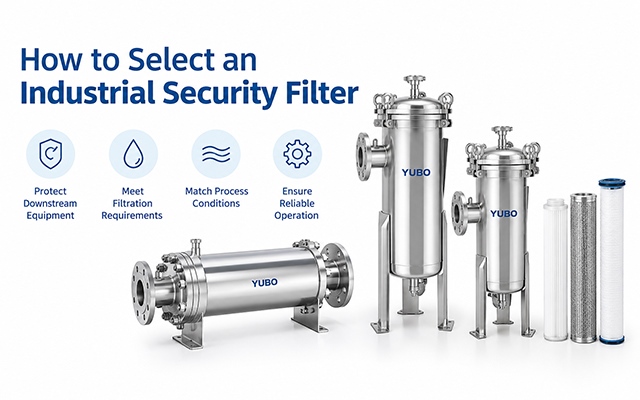
There is no single security filter configuration suitable for every RO application. Selection depends on factors such as flow requirement, feedwater characteristics, filtration rating, material compatibility, operating pressure and temperature.
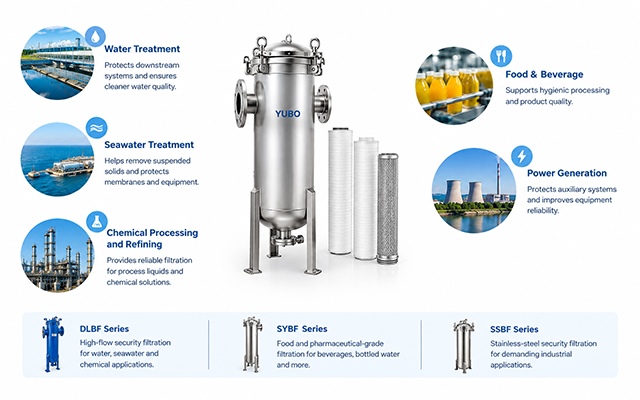
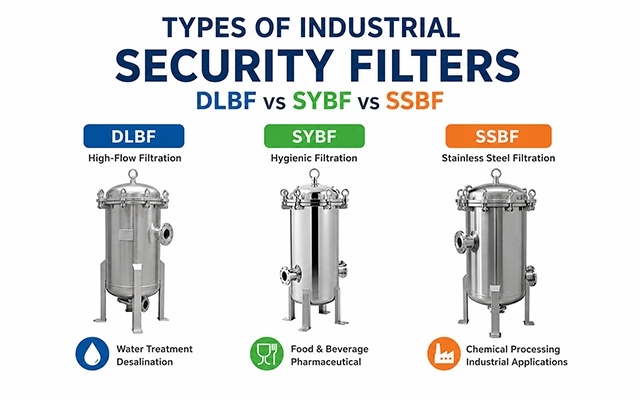
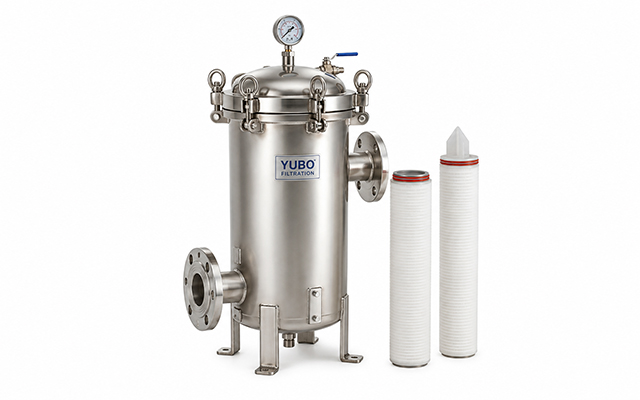
YUBO's industrial security filter range includes three configurations:
| Series | Main Positioning | Typical RO-Related Application |
|---|---|---|
| DLBF | High-flow industrial filtration | High-flow water treatment and desalination applications |
| SYBF | Hygienic process filtration | Food, beverage and pharmaceutical-related water treatment |
| SSBF | Stainless-steel industrial filtration | Desalination and demanding industrial water applications |
For a detailed comparison of these configurations, see Types of Industrial Security Filters.
Where Are Industrial Security Filters Used in RO Applications?
Security filtration can be applied wherever RO is used and additional particulate control is required.
• Industrial Water Treatment
Industrial water treatment systems may use security filtration before RO to provide an additional barrier after upstream treatment.
• Seawater Desalination
In seawater desalination, pretreatment is particularly important because suspended matter and other contaminants can affect downstream membrane equipment. A security filter can provide an additional particle-control stage before RO.
YUBO's seawater filtration portfolio includes equipment designed to help protect RO membranes and other critical equipment from suspended solids and marine contaminants.
• Process Water
RO is widely used to produce treated water for industrial processes. A security filter can help control residual particles before the membrane stage.
• High-Purity Water
Where consistent particle control is important, security filtration can be used as an additional barrier before sensitive downstream treatment.
• Food & Beverage Water Treatment
Hygienic filtration configurations can be used in water treatment applications where cleanliness and process requirements are important.
• Chemical Process Water
Chemical plants may require fine filtration before membrane treatment. Material compatibility and operating conditions should be considered when selecting the filtration equipment.
How to Select a Security Filter for an RO System?
The filter should be selected according to the actual process rather than by model name alone.
Key factors include:
• Feedwater characteristics — Understand the remaining particle load after pretreatment.
• Filtration rating — Select a suitable filtration level for the intended protection.
• Flow requirement — The filter configuration should accommodate the required process flow without unnecessary pressure loss.
• Material compatibility — Housing and filter element materials should suit the liquid and operating environment.
• Pressure and temperature — Confirm that the selected configuration matches the process conditions.
• Maintenance requirements — Consider inspection, cleaning or cartridge replacement when planning the system.
YUBO Security Filters for Industrial RO Applications
YUBO manufactures industrial filtration equipment for water treatment, seawater desalination, chemical processing, food and beverage, power generation and other applications. Its security filter range includes DLBF, SYBF and SSBF, covering different flow, material and application requirements.
YUBO's engineering and validation capabilities include structural integrity analysis, pressure testing, flow distribution testing, material qualification, durability evaluation and safety validation. These capabilities support both standard filtration equipment and application-specific configurations.
FAQ
1. What does a security filter protect?
It primarily helps protect RO membranes from residual particles and can also provide additional protection for pumps, valves, instruments and downstream processes.
2. What security filters does YUBO offer?
YUBO currently offers DLBF, SYBF and SSBF series for different industrial filtration requirements.