






Pipeline Filter Installation: Direction, Position, and Best Practices
Installing a pipeline filter correctly is important for stable filtration and convenient maintenance. The main points to check are the flow direction, installation position, connection condition, and access to the filter element. Y-type, T-type, and basket-type pipeline filters have different structures, so installation should always follow the specific filter design and manufacturer's recommendations.
Before considering installation details, it is useful to understand what a pipeline filter is and how it works.
Where Should a Pipeline Filter Be Installed?
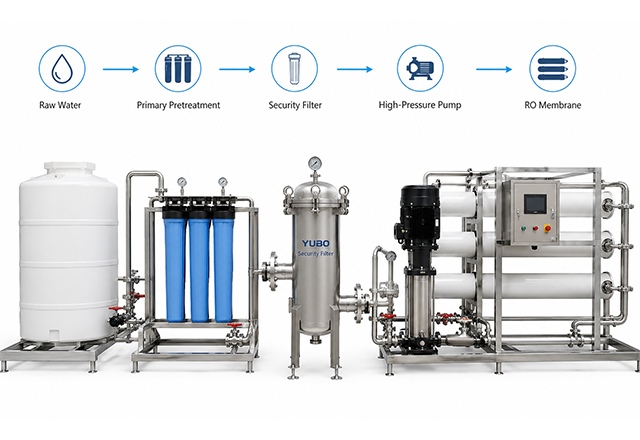
A pipeline filter is normally installed upstream of equipment that needs protection. Typical locations include the inlet side of pumps, compressors, control valves, heat exchangers, meters, and other sensitive equipment.
The purpose is straightforward: particles such as rust, welding residue, scale, sand, or process debris are intercepted before they reach downstream equipment. Your actual installation point should therefore be determined by which equipment needs protection and where solid contaminants are most likely to cause problems.
Installation Position | Typical Purpose |
Upstream of a pump | Reduce particle entry into the pump |
Upstream of a control valve | Reduce blockage and particle-related wear |
Upstream of a heat exchanger | Reduce fouling from suspended solids |
Upstream of instruments | Protect sensitive components |
Before other process equipment | Provide basic solid-particle protection |
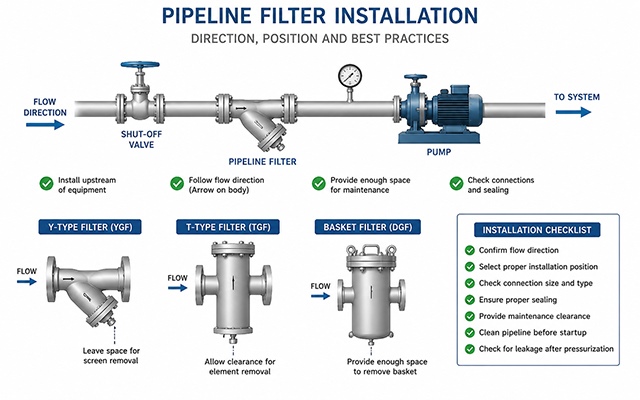
Check the Flow Direction Before Installation
The first installation check is the flow direction.
Before connecting the filter, check the arrow marked on the filter body and make sure it matches the actual direction of fluid flow. This simple check should not be skipped during installation.
The filter should also be positioned so that its filtration element can perform as intended and can be accessed when cleaning is required. Manufacturer installation instructions should take priority when a particular model has specific orientation requirements. Industrial strainer installation instructions commonly emphasize both correct flow direction and sufficient access for screen removal.
Y-Type, T-Type and Basket Filter Installation Considerations
YUBO supplies three main pipeline filter configurations: YGF Y-type, TGF T-type, and DGF basket-type/high-flow filters. Their different structures mean that installation space and element access should be considered differently.
Filter Type | Main Installation Consideration |
Y-type / Y-strainer | Confirm flow direction and provide access to the screen/filter chamber |
Basket strainer | Allow sufficient space for inspection and removal of the internal filter element |
High-flow wedge wire pipeline filter | Provide adequate clearance for basket access and routine cleaning |
For example, YGF is a compact Y-type filter with a reusable wire mesh filter cartridge and is available for horizontal or vertical installation. TGF is designed for larger pipeline applications and can use perforated, wire mesh, or wedge wire elements. DGF is a high-flow design using wedge wire elements and is intended for larger pipelines.
For product-specific installation arrangements, refer to the relevant YGF Y-Type Pipeline Filter, TGF Basket Strainer, or DGF High-Flow Pipeline Filter information.
Leave Enough Space for Cleaning and Inspection
A pipeline filter should not only fit the pipeline; it should also remain accessible after installation.
Before finalizing the piping layout, check whether there is enough space to:
• Remove and clean the filter element
• Open the filter cover where applicable
• Access the drain connection
• Inspect seals and connections
• Reinstall the element without unnecessary pipe dismantling
This point is often overlooked when equipment is installed in a crowded pipe rack or equipment area. Installation and maintenance should be considered together rather than as two separate tasks.
For ongoing cleaning requirements, see the Pipeline Filter Maintenance and Cleaning Guide.
Check Pipeline Connections Before Startup
Before commissioning, check that the filter and pipeline connections are compatible and properly aligned. Depending on the filter configuration, this may include flanged or threaded connections and the corresponding sealing components.
The upstream and downstream piping should also be free from excessive foreign material before startup. Industrial strainer installation instructions commonly recommend cleaning the connected piping and checking sealing surfaces before operation.
After the system is gradually pressurized, inspect the connections for leakage before normal operation.
Common Pipeline Filter Installation Mistakes
Common Mistake | Possible Result |
Incorrect flow direction | Improper filtration |
Insufficient maintenance space | Difficult element removal |
Poor pipe alignment | Unnecessary mechanical stress |
Incorrect sealing arrangement | Leakage |
Dirty pipeline before startup | Rapid filter loading |
These installation issues can often be avoided with a simple pre-startup inspection.
Pipeline Filter Installation Checklist
Before putting a pipeline filter into service, check:
• Flow direction: Does the arrow match the actual process flow?
• Installation position: Is the filter installed according to its design?
• Connections: Are the pipe size and connection type correct?
• Sealing: Are the gasket and sealing surfaces properly installed?
• Maintenance access: Can the screen or basket be removed?
• Pipeline condition: Is the connected piping reasonably clean?
• Leakage: Are all connections secure after initial pressurization?
If a filter is difficult to access after installation, even a well-designed filtration system can become inconvenient to maintain.
YUBO Pipeline Filter Installation Support
Pipeline filter installation depends on the filter structure, process medium, pipeline arrangement, and maintenance requirements. For this reason, YUBO does not treat installation as a one-size-fits-all procedure.
As a pipeline filter manufacturer, YUBO provides Y-type, T-type, and basket-type filtration equipment, with customized configurations available for different pipeline requirements. Product-specific installation information can be confirmed according to the selected model and actual application conditions.
Frequently Asked Questions
1. Which direction should a pipeline filter face?
The flow direction should follow the arrow marked on the filter body. Always confirm the specific product instructions before installation.
2. Can a Y-type pipeline filter be installed vertically?
Some Y-type designs, including YUBO's YGF, support horizontal or vertical installation. The actual arrangement should follow the product design and flow direction.
3. How much space is needed around a pipeline filter?
There is no single clearance value for every model. The installation area should provide enough space for inspection, cleaning, and removal of the filter element.
4. Are YGF Y-Type Pipeline Filter, TGF Basket Strainer, or DGF High-Flow Pipeline Filter installed in the same way?
No. Their internal structures and element-removal arrangements differ, so the installation position and maintenance access should be checked for the specific filter model.