






Pipeline Filter Structure and Components: A Guide to Industrial Filter Design
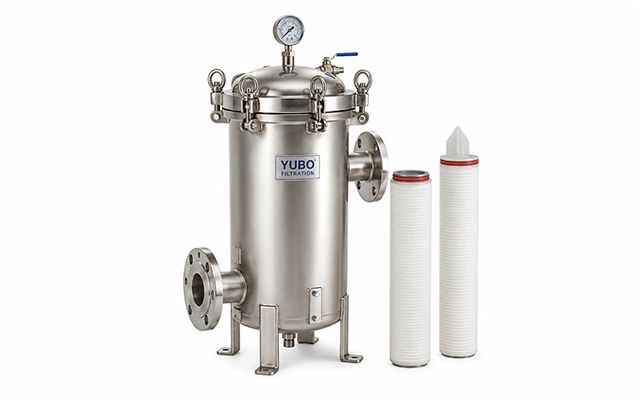
Industrial pipeline filters are built as complete filtration systems rather than a single filtering part. The housing, filtration element, sealing structure, and connection design work together to ensure stable operation under different pipeline conditions.
The structure of a pipeline filter directly affects filtration accuracy, pressure loss, maintenance requirements, and service life. For this reason, industrial users usually select or customize filter designs according to fluid characteristics, operating pressure, flow rate, and installation requirements.
For a complete guide, visit our Pipeline Filter Guide and Work Principles
Main Components of an Industrial Pipeline Filter
A standard pipeline filter mainly consists of:
• Filter housing
• Filtration element
• Cover and closure system
• Inlet and outlet connections
• Sealing components
Each component has a specific function in the filtration process and influences the overall performance of the equipment.
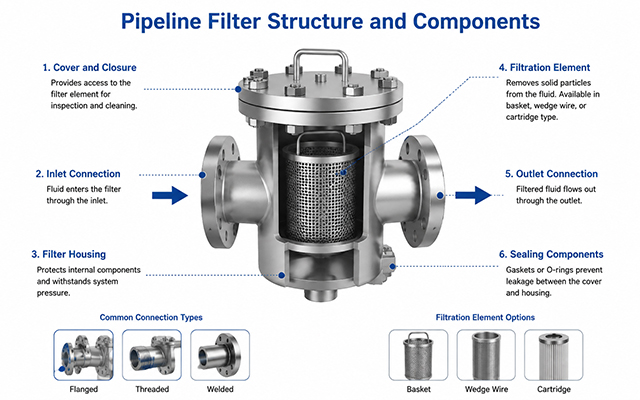
1. Filter Housing: The Foundation of Pipeline Filter Structure
The filter housing is the pressure-bearing body of the pipeline filter. It contains the internal filtration element and provides the flow passage between the inlet and outlet.
The housing design determines:
• Pressure resistance
• Flow capacity
• Material compatibility
• Installation method
Housing Material Selection
A. Stainless Steel Pipeline Filter Housing
Stainless steel is commonly used for applications requiring corrosion resistance and clean operation, such as:
• Chemical processing
• Food and beverage production
• Water treatment
• Pharmaceutical industries
B. Carbon Steel Pipeline Filter Housing
Carbon steel is widely used in general industrial applications where mechanical strength and cost efficiency are important.
The final material choice depends on the fluid type, temperature, pressure, and operating environment.
2. Filtration Element: The Core Part of Particle Removal
The filtration element is the component that separates contaminants from the process fluid.
Different industrial applications require different filtration element designs.
A. Basket Filter Element
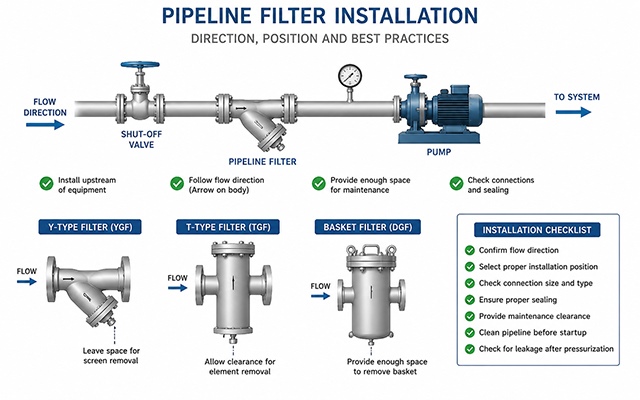
Basket-type elements are commonly used in pipeline filters where regular cleaning and particle removal are required. TGF uses a removable basket-type filtration element for applications requiring practical cleaning and higher debris-holding capacity.
Key characteristics:
• Large filtration area
• High dirt holding capacity
• Easy removal and cleaning
They are often used to protect pumps, valves, heat exchangers, and other downstream equipment.
B. Wedge Wire Filter Element
Wedge wire screens are widely applied in industrial filtration systems where high strength and precise filtration openings are required.
Advantages include:
• Accurate slot opening control
• Strong mechanical structure
• Good corrosion resistance
• Long service life
As a manufacturer of wedge wire filtration components, YUBO can customize filter elements according to specific requirements, including slot size, diameter, length, material, and installation structure.
C. Cartridge Filter Element
Cartridge elements are used when finer filtration accuracy and replaceable filtration media are required.
3. Cover and Closure Design
The cover structure provides access to internal filtration components while maintaining sealing performance during operation.
Common designs include:
A. Bolted Cover
Suitable for industrial systems requiring secure sealing and pressure resistance.
B. Removable Cover
Designed for applications where frequent inspection, cleaning, or filter replacement is required.
The closure design directly affects maintenance convenience and equipment downtime.
4. Pipeline Filter Connection Types
The connection design allows the filter to integrate with existing pipeline systems.
A. Flanged Connection
Commonly used for industrial pipelines because of its strong connection and convenient installation.
B. Threaded Connection
Suitable for smaller pipeline systems with limited installation space.
C. Welded Connection
Used when permanent installation and high leak prevention requirements are needed.
Connection selection depends on pipeline size, pressure rating, and customer installation standards.
5. Sealing System
The sealing structure prevents leakage during filtration operation.
Common sealing components include:
• Gaskets
• O-rings
• Sealing rings
Seal materials are selected according to:
• Temperature range
• Chemical compatibility
• Operating pressure
A suitable sealing design improves operational safety and equipment reliability.
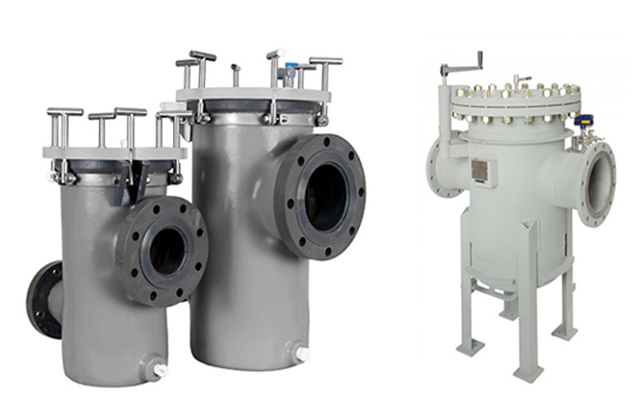
How Pipeline Filter Components Work Together
During operation, contaminated fluid enters the filter through the inlet connection.
The filtration process follows:
Dirty fluid → Filter housing → Filtration element → Particle retention → Clean fluid outlet
The filtration element removes unwanted particles, while the housing maintains structural strength and the sealing system prevents leakage.
The final filtration performance depends on how these components are designed and matched together.
Customized Pipeline Filter Design for Different Industrial Requirements
Pipeline filtration requirements vary significantly between industries. Standard filter designs may not always meet specific flow, pressure, material, or installation conditions.
YUBO provides customized pipeline filter solutions based on customer requirements, including:
• Filter housing dimensions
• Filtration element design
• Filtration accuracy
• Connection standards
• Material selection
• Operating conditions
With manufacturing experience in industrial filtration equipment and wedge wire screen production, YUBO supports customers from filtration design to finished filter manufacturing.
YUBO Pipeline Filter Products
YUBO pipeline filter solutions include:
Designed for industrial pipeline filtration applications requiring reliable particle removal and practical maintenance.
Suitable for different process filtration systems with customized structural options.
Designed according to specific pipeline installation and filtration requirements.
Each model can be configured according to the customer's operating conditions and filtration objectives.
Frequently Asked Questions
1. What are the main components of a pipeline filter?
The main components include the filter housing, filtration element, cover system, pipeline connections, and sealing components.
2. Which component determines pipeline filter filtration accuracy?
The filtration element mainly determines filtration accuracy because its opening size and material structure control particle removal.
3. Can pipeline filters be customized?
Yes. Pipeline filters can be customized in terms of housing size, filtration element design, material, connection type, and operating requirements.
4. Why is filter housing design important?
The housing affects pressure resistance, flow performance, installation compatibility, and service life.