






Industrial Security Filter Structure and Components
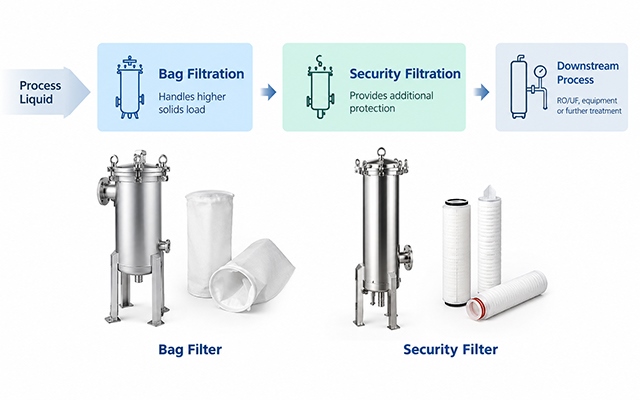
An industrial security filter is built around a housing, filter elements, sealing parts, and pipeline connections. Each component affects how the filter handles process pressure, retains particles, and allows routine maintenance.
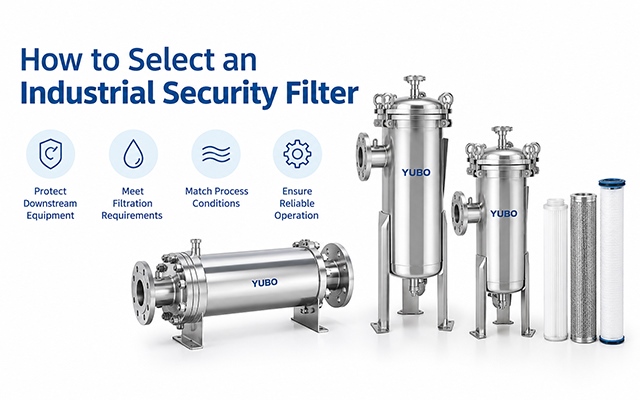
At YUBO, we manufacture industrial security filters in different configurations to meet application requirements. Housing materials, filter elements, connection types, and other details can be selected according to the process conditions and equipment specifications.
What Are the Main Components of an Industrial Security Filter?
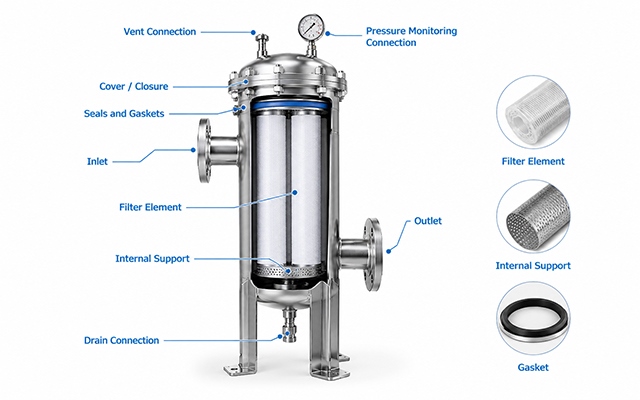
The main components of a cartridge-based industrial security filter include:
| Component | Function |
| Filter housing | Contains the process liquid and filter elements |
| Filter element | Retains particles from the liquid |
| Internal support | Holds the filter element in position, depending on the design |
| Cover or closure | Seals the housing and provides access for maintenance |
| Seals and gaskets | Prevent leakage and unfiltered liquid bypass |
| Inlet and outlet | Connect the filter to the process pipeline |
| Vent and drain connections | Allow air release or liquid drainage when provided |
| Pressure monitoring connections | Support pressure measurement when included in the design |
The exact structure varies by model. Not every filter includes all the auxiliary connections listed above.
1. Filter Housing
The housing contains the filter elements and withstands the specified operating conditions. Its material and construction must suit the process liquid, operating pressure, and temperature.
Stainless steel is widely used in industrial security filters, but the appropriate grade depends on the fluid and service environment. Housing size, closure design, and internal arrangement also affect installation and element replacement.
YUBO manufactures stainless steel security filters in different configurations. For applications requiring a specific housing arrangement or material, we can discuss customized options based on the operating conditions.
2. Filter Elements
The filter element is the component that retains suspended particles as liquid passes through the filtration media.
Element material and filtration rating should match the process requirements. Flow rate, contaminant load, liquid compatibility, and operating conditions also affect element selection.
Different applications may require different media. For example, our DLBF high-flow security filterrange uses deep-layer polypropylene or glass-fiber filter media, depending on the selected configuration. The appropriate element should be confirmed against the required filtration performance and process conditions.
3. Internal Supports and Sealing Parts
Internal supports or locating components keep the filter elements correctly positioned inside the housing. Their design depends on the element type and filter construction.
Seals and gaskets prevent leakage at the relevant connection points and help stop unfiltered liquid from bypassing the filter element. Incorrect installation, worn seals, or damaged sealing surfaces may compromise filtration performance.
During element replacement, check the sealing parts and follow the installation instructions for the specific filter model.
4. Cover and Closure
The cover or closure provides access to the filter elements for inspection and replacement. It also forms part of the sealed housing during operation.
Closure arrangements vary with the filter design and maintenance requirements. Before opening the housing, isolate the equipment, release the pressure, and drain the retained liquid in accordance with the operating procedure.
5. Inlet, Outlet, and Auxiliary Connections
The inlet and outlet connect the filter to the process pipeline. Their size, type, and orientation must match the installation requirements.
Depending on the design, a filter may also include:
• Vent connection: For releasing trapped air where required.
• Drain connection: For draining liquid during maintenance.
• Pressure monitoring points: For checking operating pressure or differential pressure when the system is equipped for monitoring.
These features are configuration-dependent. Confirm their availability and location before ordering a filter.
Do All Industrial Security Filters Have the Same Structure?
No. The basic components may be similar, but the internal arrangement, element configuration, housing dimensions, and auxiliary connections vary by model and application.
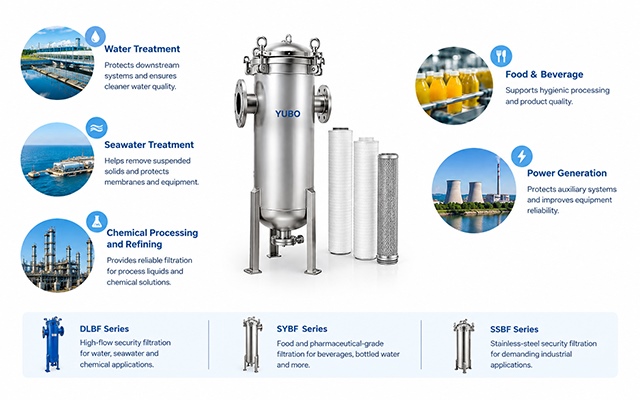
YUBO supplies industrial security filter configurations for different flow requirements and process conditions. Our DLBF, SYBF, and SSBF series serve different filtration needs, so the suitable construction depends on the intended application rather than a single standard arrangement.
For a comparison of these filter types, see our industrial security filter types.
What Should Be Checked During Maintenance?
Regular inspection helps identify component wear and potential operating problems. Depending on the filter design, maintenance checks may include:
• Filter element condition and correct installation.
• Seals and gaskets for wear or damage.
• Housing, cover, and closure condition.
• Pipeline connections for leakage.
• Pressure readings, where monitoring instruments are installed.
Always depressurize and isolate the filter before opening it. Cleaning and replacement procedures depend on the filter element and the process requirements.
Need a Custom Industrial Security Filter?
YUBO manufactures industrial security filters with configurations tailored to process conditions, filtration requirements, and installation needs. Share your required flow rate, operating pressure, temperature, process liquid, and filtration rating with our team to discuss a suitable filter configuration.