






Common Pipeline Filtration Problems and Solutions | YUBO Filtration
Pipeline filtration problems such as pressure drop, filter clogging, corrosion, and reduced flow rate are common in industrial fluid systems. Most of these issues can be prevented by selecting the correct filter type, using suitable materials, and following proper maintenance procedures.
At YUBO Filtration, we provide engineered pipeline filtration solutions for chemical processing, water treatment, refining, food production, and industrial fluid systems.
For a complete guide, visit our Pipeline Filter Guide and Work Principle
1. Excessive Pressure Drop
✔ Problem
A rising pressure drop across the filter usually indicates that contaminants are accumulating inside the filter element or basket.
Common signs include:
• Reduced downstream flow
• Increased pump load
• Unstable system pressure
• Frequent maintenance shutdowns
✔ Main Causes
| Cause | Description |
|---|---|
| Filter clogging | Particles block the filtration surface |
| Incorrect micron rating | Overly fine mesh restricts flow |
| Undersized filter | Filtration area is too small |
| High fluid viscosity | Thick liquids increase resistance |
✔ Solutions
Clean or replace the filter element regularly
Select a suitable micron rating based on actual particle size
Increase filtration area for high-solid applications
Use basket or T-type strainers for higher flow systems
2. Frequent Filter Clogging
✔ Problem
Filters that clog too quickly increase maintenance costs and reduce production efficiency.
✔ Main Causes
| Cause | Description |
|---|---|
| Excessive solid particles | High contaminant concentration |
| Incorrect filter type | Filter not designed for the process |
| Poor upstream control | Debris enters the system continuously |
| Small filtration area | Limited dirt-holding capacity |
✔ Solutions
• Use Multi-Stage Filtration
Installing a coarse pre-filter before fine filtration reduces the load on the main filter.
• Select the Correct Filter Design
High-flow pipeline filters (DGF)
• Monitor Differential Pressure
Pressure monitoring helps determine the correct cleaning interval instead of relying only on fixed schedules.
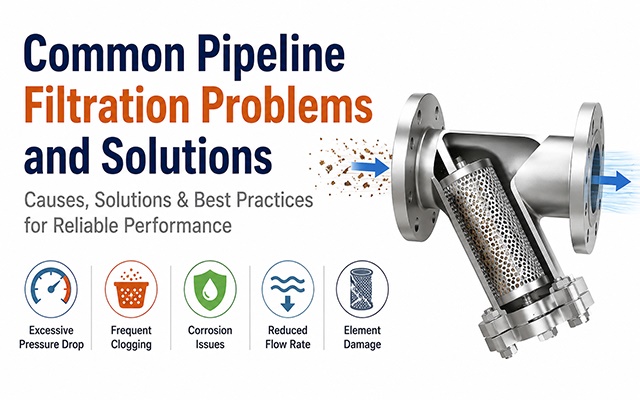
3. Corrosion Inside the Filter Housing
✔ Problem
Corrosion may damage the filter housing, screen, or basket, eventually causing leakage or contamination.
✔ Main Causes
| Cause | Description |
|---|---|
| Incompatible material | Fluid reacts with filter metal |
| Chloride exposure | Common in seawater systems |
| High temperatures | Accelerate corrosion |
| Poor material quality | Reduced durability |
✔ Solutions
Use SS316 stainless steel for corrosive fluids
Verify chemical compatibility before installation
Inspect welded areas during maintenance
Use corrosion-resistant materials in seawater or chemical systems
4. Reduced System Flow Rate
✔ Problem
A gradual reduction in flow rate usually indicates blockage or installation issues.
✔ Main Causes
| Cause | Description |
|---|---|
| Partial blockage | Debris accumulation |
| Incorrect installation | Wrong flow direction |
| Air trapped in the pipeline | Restricts fluid movement |
| Damaged filter basket | Reduces effective filtration area |
✔ Solutions
Confirm the filter is installed in the correct flow direction
Remove trapped air from the system
Inspect baskets and screens for deformation
Verify pipeline sizing and system design
5. Filter Element Damage
✔ Problem
Filter baskets or screens may deform, crack, or collapse under difficult operating conditions.
✔ Main Causes
| Cause | Description |
|---|---|
| Excessive pressure differential | High pressure damages the screen |
| Water hammer | Sudden pressure shock |
| Weak filter media | Insufficient structural strength |
| Improper cleaning | Mechanical damage during maintenance |
✔ Solutions
Use reinforced wedge wire or perforated screens
Replace filters before pressure becomes excessive
Install pressure protection devices
Follow correct cleaning procedures
Best Practices for Preventing Filtration Problems
| Best Practice | Benefit |
|---|---|
| Monitor pressure differential | Detect clogging early |
| Schedule regular inspections | Prevent unexpected downtime |
| Select proper filter materials | Improve corrosion resistance |
| Use suitable filter sizing | Maintain stable flow |
| Train maintenance personnel | Reduce installation errors |
Frequently Asked Questions
1. What is the most common pipeline filtration problem?
Filter clogging caused by excessive contaminants is the most common issue in industrial filtration systems.
2. How often should a pipeline filter be cleaned?
Cleaning frequency depends on contaminant load, operating conditions, and filter type. Differential pressure monitoring is usually the best indicator.
3. Which filter is suitable for high-flow applications?
Basket strainers (TGF) and High-flow pipeline filters (DGF) are commonly used in high-flow industrial systems because they offer larger filtration areas.
4. What material is recommended for corrosive fluids?
SS316 stainless steel is widely used for chemical processing and seawater applications due to its corrosion resistance.
More FAQs: Pipeline Filter&Strainer Common Questions Answered
Most pipeline filtration problems can be prevented through proper filter selection, material compatibility, and routine maintenance. Common issues such as clogging, pressure drop, corrosion, and reduced flow are often early warning signs that the filtration system requires adjustment or servicing.
Choosing the right Y strainers (YGF), Basket strainers (TGF), and High-Flow pipeline filters (DGF) improves operational reliability while reducing maintenance costs and unplanned downtime.
Contact YUBO Filtration
Email: info@yubofiltration.com
WhatsApp:86 13653285589